What Do Men Deserve Actually ?
There are very few things that can turn a serious social conversation into an internet meme as quickly as food. In India, almost everything can become a meme eventually, but the recent “Ek kachori, do samosa, in mardon ka kya bharosa” slogan has taken that tradition to another level. What began as a slogan associated with women’s safety protests in Delhi quickly travelled across social media, where kachoris, samosas, memes, reels and jokes became part of a much larger conversation about men and women.
The slogan attracted attention precisely because it was unusual. It was short, catchy and rhymed like something one might hear while ordering snacks at a roadside stall. At the same time, it was connected to a serious issue: women’s safety and anger over sexual violence. Recent reporting around the protests highlighted how younger protesters are increasingly using humour, pop culture references and social media friendly language to make their messages more visible. Once the slogan reached Instagram, X and other platforms, however, the conversation inevitably expanded beyond the original protest.
Some people laughed at the meme. Some supported the message behind the protest. Some men questioned whether it was fair to generalise about an entire gender. Others responded by bringing up men’s mental health, loneliness, marriage, divorce, false allegations and the pressures associated with being a man in India. Before long, the kachori and samosa were no longer simply food. They had become symbols in another chapter of India’s never ending online men versus women debate.
But once the jokes are over and the memes stop circulating, there is a more interesting question underneath all of this: what do men deserve actually?
The answer does not have to be about men deserving more than women. It does not have to be a response against feminism, women’s rights or women’s safety. In fact, turning the question into another gender competition would completely miss the point. The more useful question is what an ordinary man deserves as a human being, and whether modern society is actually giving him those things.
“Ek Kachori, Do Samosa” Meme and Why It Went Viral?
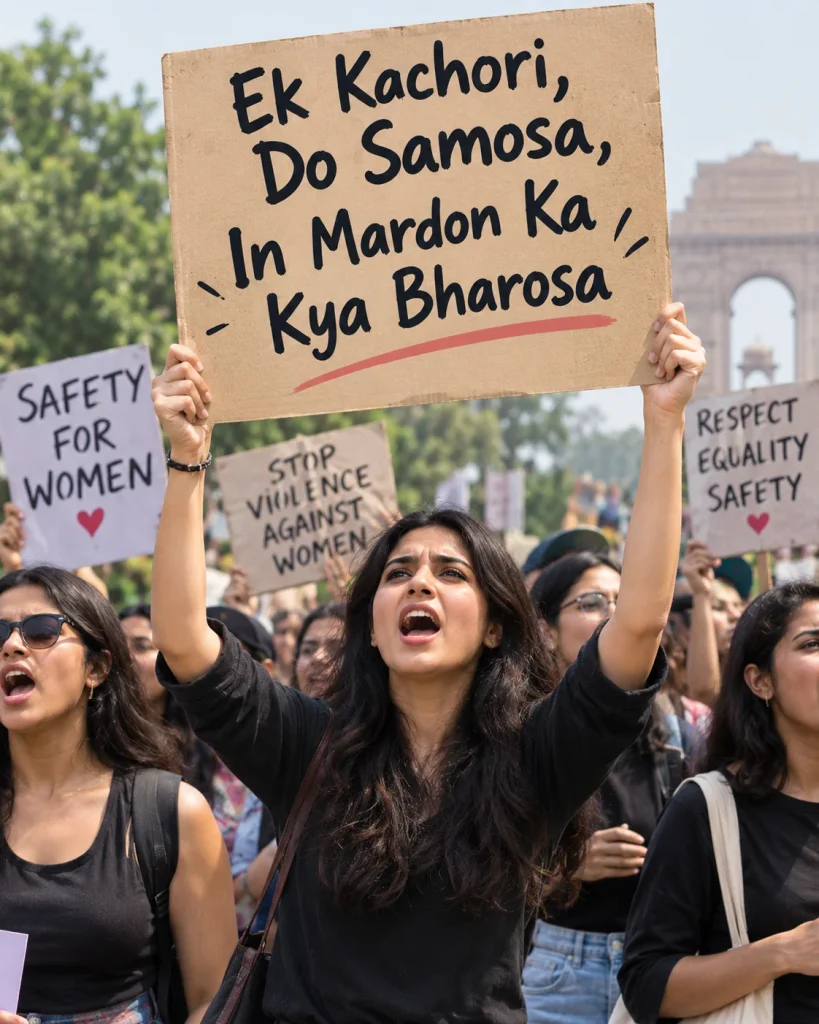
The popularity of the kachori samosa slogan says something interesting about the way Indians communicate in the age of social media. Protests were once primarily about speeches, placards, marches and newspaper coverage. Today, a protest also has to compete with Instagram Reels, memes, short videos and an audience with an extremely short attention span. A slogan that can be remembered after hearing it once has an enormous advantage over a complicated statement that requires several minutes to understand.
That is why humour has become such an important part of online activism. A serious statement can be ignored, while a funny sentence can be shared thousands of times. People who may never read a detailed article about women’s safety might still see a kachori samosa meme and become curious about where the phrase came from. In that sense, memes are no longer merely jokes. They have become a form of cultural communication.
The phrase also became more interesting because social media users connected its wording with an older Taarak Mehta Ka Ooltah Chashmah reference involving a similar kachori samosa rhyme. As expected, Indian internet users quickly turned that coincidence into another meme, with people joking that the popular television show had somehow predicted yet another future event.
This is typical of Indian internet culture. A serious issue becomes a slogan, the slogan becomes a meme, the meme becomes a pop culture reference, and the pop culture reference becomes another debate. The original issue can easily get buried beneath the entertainment surrounding it.
That is where the conversation about men becomes important.
The question should not simply be whether the slogan is funny or offensive. The more important question is why a simple slogan about men can trigger such an intense reaction in the first place.
Why the Conversation About Men Has Become So Complicated?
Being a man in India has never come with a single definition, but traditional expectations have often been remarkably consistent. Boys are taught from a young age that they should become strong, responsible and financially independent. They are expected to protect their families, build careers, earn money and eventually become providers. Emotional vulnerability, meanwhile, is often treated as something that should be controlled rather than expressed.
These expectations are not necessarily bad in themselves. Responsibility, discipline and the desire to provide for one’s family can be positive qualities. The problem begins when these qualities become the only acceptable definition of masculinity. When a man’s entire identity becomes connected to how much he earns, how successful he is, how physically strong he appears or how well he can handle problems without asking for help, ordinary human struggles can start to feel like personal failures.
A man who loses his job may not simply feel unemployed; he may feel that he has failed as a man. A man who cannot financially support his family may experience shame that goes far beyond his economic circumstances. A man going through a difficult breakup may feel that admitting how deeply it affected him will make him appear weak. A man experiencing anxiety or depression may avoid seeking professional help because he has spent his entire life hearing that he should simply “man up.”
This is one reason the question “What do men deserve?” deserves a serious answer.
Men deserve the opportunity to exist outside the narrow expectations that society has traditionally placed on them.
Men Deserve to Talk About Their Mental Health

One of the most important issues affecting men today is mental health. India has made progress in talking about mental health, but stigma remains particularly strong when it comes to men. Many men have been raised to believe that emotional problems should be solved privately. If something goes wrong, they are expected to deal with it, move on and continue fulfilling their responsibilities.
Recent research into young Indian men has highlighted this contradiction. Young men are navigating an environment in which traditional expectations around masculinity remain strong while the economic and social realities of modern life have changed significantly. Financial insecurity, career pressure, changing relationship expectations and social isolation can create enormous stress, yet many men still feel uncomfortable admitting that they are struggling.
The problem is not that men are incapable of talking. The problem is that many men have never been given a safe environment in which talking about difficult emotions feels normal. A man may be perfectly comfortable discussing cricket, politics, cars, business or technology with his friends, but the conversation can become uncomfortable when someone asks what is actually happening in his personal life.
This is why phrases such as “men don’t talk about their feelings” can be misleading. Men do talk. They simply do not always have the language, environment or social permission to discuss vulnerability.
A healthier society would not ask men to become emotionally dependent on everyone around them. It would simply make it acceptable for a man to say that he is struggling without immediately questioning his masculinity.
Men Deserve the Freedom to Cry Without Being Called Weak
The idea that men should not cry begins surprisingly early. A young boy falls and starts crying, and someone tells him to get up. A teenager experiences heartbreak and is told to forget about it. A young man loses an opportunity and is told that failure is part of life. Eventually, many men learn that showing emotional pain is something they should avoid.
Yet crying is not a character defect. It is a normal human response to grief, frustration, fear, sadness and even overwhelming happiness. There is nothing inherently masculine or feminine about having emotions.
The real issue is that men are often expected to demonstrate emotional control without being taught emotional understanding. There is an enormous difference between being emotionally stable and being emotionally suppressed. A person who understands his emotions can acknowledge anger, sadness, fear or disappointment and still make sensible decisions. Someone who simply suppresses those emotions may appear strong while carrying significant internal stress.
Men should be encouraged to develop emotional resilience rather than emotional silence. There is nothing weak about telling a friend, partner, parent or professional that something is hurting you. In many situations, recognising that you need help is actually an indication of self awareness.
Men Deserve to Be Valued for More Than Their Money
Perhaps one of the strongest expectations placed on Indian men is the expectation to provide. From family conversations to marriage discussions, a man’s career and income can become central to how others evaluate him. His occupation is often one of the first things people ask about when they meet him, and his financial stability can influence how society perceives his success.
Financial responsibility is important, of course. Families need money, and earning a living is a fundamental part of adulthood. But there is a difference between recognising the importance of financial stability and defining an entire human being through his earning capacity.
A man who earns ₹30,000 a month is not inherently less respectable than someone earning ₹3 lakh. A businessman whose company fails does not suddenly become a failure as a person. A young man who is still building his career should not have to feel ashamed because he has not reached someone else’s definition of success.
The pressure becomes particularly visible in marriage and dating. Men are frequently expected to demonstrate financial stability before they are considered ready for serious relationships. Again, there is nothing wrong with wanting financial compatibility in a relationship. The problem arises when financial success becomes almost synonymous with personal worth.
Men deserve relationships and families where their contribution is recognised in broader terms. Income matters, but kindness matters too. Responsibility matters, but emotional presence matters too. Providing money is valuable, but providing companionship, support and care is also valuable.
Men Deserve to Be Fathers, Not Just Providers
The role of the father is changing in modern families. Earlier generations often associated fatherhood primarily with earning money and maintaining authority within the household. Today, many fathers want a more active role in their children’s lives. They want to attend school events, help with homework, cook meals, change diapers, play with their children and talk about emotions.
That change should be encouraged.
A child does not only need a father who pays the bills. A child needs a father who is emotionally present. Children remember conversations, affection, encouragement and time spent together just as much as they remember the material things their parents provided.
Unfortunately, men can sometimes be discouraged from taking on nurturing roles because caregiving is still stereotypically associated with women. A father who stays home with his child or takes primary responsibility for childcare should not be considered less masculine. Changing a diaper does not make a man less of a man. Cooking dinner does not make him less masculine. Being emotionally available does not reduce his authority.
It simply means he is participating fully in his family.
Men deserve that opportunity.
Men Deserve Healthy Relationships
The modern relationship conversation has become increasingly complicated because social media has turned dating into a constant stream of advice, warnings, rules and gender based generalisations. One video tells men to become “high value.” Another tells women never to settle. One creator says men are the problem. Another says women are the problem. Dating is increasingly discussed as if men and women are opposing teams trying to gain an advantage over each other.
Real relationships rarely work like that.
A healthy relationship involves two individuals with different personalities, experiences, expectations and weaknesses trying to build something together. Both people make mistakes. Both need to communicate. Both need boundaries. Both should be able to express their needs. Both should be accountable for their behaviour.
Men deserve relationships in which they can be themselves rather than constantly performing a particular version of masculinity. They should not have to pretend that they never feel insecure, never need reassurance or never experience emotional pain.
A man who wants affection is not weak. A man who wants emotional closeness is not needy simply because he has feelings. A man who wants a partner who respects him is not asking for something unreasonable.
At the same time, healthy masculinity also requires men to respect the boundaries and autonomy of their partners. Men’s rights should never become an excuse for controlling women, and women’s rights should never require men to surrender their own dignity.
A healthy relationship is not about winning.
It is about mutual respect.
Men Deserve Fairness in Marriage and the Legal System
The subject of men and marriage can become extremely polarised, particularly when conversations involve divorce, domestic disputes, maintenance, custody and allegations of abuse. Genuine victims need protection and access to justice, but concerns about misuse of legal processes also deserve to be examined objectively.
The solution cannot be to automatically believe or disbelieve someone based on gender.
A genuine victim deserves justice. A person who has been falsely accused deserves due process. These principles are not mutually exclusive.
The legal system should be based on evidence, investigation and fair procedure. A person’s gender should not automatically determine whether they are believed, protected or condemned.
This is especially important in an era where digital evidence can be manipulated and social media can turn allegations into public trials before courts have had an opportunity to examine the facts.
Men deserve the same fundamental principle that every person deserves: justice should be based on evidence rather than stereotypes.
Men Deserve to Be Victims Without Being Mocked
One of the least discussed aspects of men’s issues is the difficulty some men experience in acknowledging that they have been victims of abuse.
A man can be physically abused. He can experience emotional abuse. He can be sexually assaulted. He can be financially manipulated. He can be controlled by a partner. He can experience domestic violence.
Yet cultural stereotypes sometimes make it difficult for men to speak about these experiences. The assumption that a man should always be physically stronger or emotionally tougher can make male victims feel embarrassed about asking for help. Some fear that people will laugh at them or question their masculinity.
That needs to change.
Being a victim does not make someone weak. Experiencing abuse does not make someone less masculine. Seeking help does not make someone less of a man. If society expects men to protect vulnerable people, it should also be willing to protect men when they themselves become vulnerable.
Men Deserve Accountability Too
Talking about men’s problems should never become an excuse to defend bad behaviour.
There is an important difference between saying that men deserve fairness and saying that men should never be criticised. Those are completely different ideas.
Men who commit violence should be held accountable. Men who harass others should be held accountable. Men who abuse their partners should be held accountable. Men who exploit people should be held accountable.
In fact, a healthier understanding of masculinity should encourage greater accountability. Being a good man does not mean defending another man simply because he is a man. Sometimes being a good friend or brother means telling another man that his behaviour is unacceptable.
Men deserve empathy, but they also deserve honest feedback.
Accountability is not hatred.
Accountability is part of respect.
Men Deserve Better Friendships
Male friendship is often portrayed as something simple: two friends watching cricket, going out for food, playing games or making jokes together. Those things are important, but friendship can go much deeper.
Many men have friends they have known for years but still struggle to discuss serious personal problems with them. Conversations may revolve around work, money, sports, politics, entertainment and relationships without ever reaching the question of how someone is actually doing.
There is nothing wrong with those friendships. Men do not need to turn every conversation into therapy. But they should have at least one or two relationships where vulnerability is possible.
Sometimes the most valuable thing one man can say to another is not advice.
It is simply: “Are you actually okay?”
Men deserve friendships where the answer can be honest.
Men Deserve the Freedom to Fail
Modern society celebrates successful men constantly. Entrepreneurs, athletes, actors, CEOs and influencers are presented as examples of what men should aspire to become. Success can be motivating, but it also creates a dangerous illusion that a man’s life should always move upward.
Real life does not work that way.
People lose jobs. Businesses fail. Relationships end. Investments go wrong. Careers change direction. Dreams don’t always work out.
Men deserve the freedom to fail without believing that failure makes them worthless. A failed business does not mean a failed person. A rejected job application does not define someone’s intelligence. A failed relationship does not mean someone is incapable of love.
Failure is part of being human.
Men should be allowed to start again.
Men Deserve Appreciation Without Having to Be Heroes
There is another part of the conversation that often gets overlooked: ordinary men deserve appreciation too.
The father who works long hours. The brother who helps his family. The son who supports his parents. The friend who shows up when someone needs help. The husband who quietly takes responsibility. The colleague who stays late to finish a task.
Not every contribution needs to become a dramatic story about sacrifice. Sometimes people simply do what needs to be done. But that doesn’t mean it should never be acknowledged.
A simple “thank you” can mean a lot.
Men should not have to become extraordinary before their effort is noticed.
Biggest Problem With the “Men vs Women” Debate
Perhaps the biggest problem with today’s gender conversations is that everything is treated like a competition.
Women talk about safety and men respond with men’s problems. Men talk about mental health and women respond with women’s problems.
Women discuss discrimination and men discuss economic pressure. Men discuss loneliness and women discuss harassment.
Eventually, everyone is comparing suffering instead of solving problems.
But pain is not a competition. Acknowledging men’s mental health problems does not diminish women’s experiences. Acknowledging women’s safety concerns does not require men to remain silent about their own problems.
Both conversations can exist at the same time.
In fact, they should. The goal of equality should not be to determine which gender suffers more. It should be to create a society where fewer people suffer unnecessarily.
What Does Modern Masculinity Actually Mean?
Perhaps the question we should be asking is not whether masculinity is good or bad, but what kind of masculinity we want to encourage.
A man can be strong without being aggressive. He can be confident without being arrogant. He can provide financially without believing that money gives him control over other people. He can protect his family without controlling them. He can be ambitious without becoming emotionally unavailable.
He can also cry.
He can ask for help.
He can cook.
He can care about grooming.
He can be a stay at home father.
He can enjoy fashion.
He can talk about mental health.
None of those things make him less of a man.
Perhaps modern masculinity should be less about proving that you are a man and more about becoming a decent human being.
So, What Do Men Deserve?
After all the debates, memes, arguments and social media controversies, the answer is surprisingly simple.
Men deserve respect without having to constantly prove their worth. Men deserve mental health support without being called weak. Men deserve relationships based on mutual respect rather than financial or gender based expectations. Men deserve fairness when they are victims and due process when they are accused. Men deserve accountability when they do something wrong. Men deserve the opportunity to be involved fathers, supportive partners, loyal friends and emotionally present human beings.
Men deserve the freedom to fail and try again. Men deserve the freedom to say that they are scared, confused, exhausted or hurt. Men deserve the ability to ask for help without feeling that doing so makes them less masculine.
Most importantly, men deserve to be seen as individuals.
A man is not every bad man.
He is not every good man either.
He is not his salary.
He is not his muscles.
He is not his relationship status.
He is not his car.
He is not his job.
He is not an “alpha,” “beta” or “sigma.”
He is a human being with his own personality, choices, strengths, weaknesses, experiences and responsibilities.
What About the Kachori and Samosa?
And now we return to where this conversation started. “Ek kachori, do samosa, in mardon ka kya bharosa.”
Maybe the phrase will remain a viral meme for a few days. Maybe another meme will replace it next week. That is how the internet works.
But perhaps it can also lead to a more meaningful conversation.
Women’s safety deserves to be taken seriously. Men deserve to be taken seriously too. Violence should be condemned regardless of who commits it. Victims should receive support regardless of their gender. False allegations should be investigated fairly. Men should be able to discuss their mental health. Women should be able to discuss their safety. Neither conversation needs to silence the other.
The answer isn’t to create another battle between men and women.
The answer is to create a culture where people are judged by their actions rather than stereotypes.
So, what do men deserve actually ?
They deserve dignity. They deserve fairness. They deserve emotional support. They deserve healthy relationships. They deserve meaningful friendships. They deserve justice. They deserve opportunities. They deserve the freedom to fail. They deserve the freedom to ask for help. They deserve the freedom to express emotions. They deserve appreciation for what they contribute. They deserve accountability when they do wrong and compassion when they are struggling.
And yes, after everything we’ve discussed, they probably deserve a kachori, two samosas and a cup of chai. But perhaps the most important thing men deserve isn’t food, money, status or even success.
Men deserve the freedom to be human without constantly having to prove that they are a man.
And if that sounds like too much to ask, maybe the problem isn’t men. Maybe the problem is the definition of masculinity we’ve been carrying for too long.
Final Thoughts
The “ek kachori, do samosa” meme may have started as a joke, but it has opened a much bigger conversation about what men deserve. Beyond the memes, stereotypes and gender wars, men also deal with loneliness, emotional pressure, relationship struggles, family responsibilities and the expectation to always be strong. These issues deserve to be discussed without turning every conversation into a battle between men and women.
Men don’t deserve more than women, and they certainly don’t deserve less. Men deserve respect, fairness, emotional freedom, healthy relationships, the right to be heard and the freedom to fail, cry, change and ask for help without being mocked. At the same time, talking about men’s struggles should never mean dismissing the struggles of women. A mature society should have enough space to acknowledge both.
Maybe the real question isn’t “What do men deserve?” but “What does every human being deserve?” The answer is simple: dignity, understanding, fairness and a chance to live without constantly proving their worth. So, let the memes continue, let the kachori and samosa jokes continue; but perhaps the conversation should go beyond the joke, because behind every meme is a real person, and sometimes what men deserves most is simply to be understood.
What’s Trending!

Nani’s Bloody Romeo Mullet Haircut: Trending Men’s Hairstyles in India.
Nana Patekar Dies at 75: The Voice, Rage and Soul of Indian Cinema Falls Silent.

1 Kachori, 2 Samosa… In Mardon Ka Kya Bharosa. What Do Men Deserve Actually?

How to Stop Hair Fall in Men: 10 Practical Ways to Reduce Hair Loss and Support Hair Growth.

First Poster Unveils Ranbir Kapoor in Love & War: Ranbir Kapoor’s Rugged Air Force Look Sparks Massive Buzz.